In this guide
- Why do puppies bite so much?
- What is bite inhibition, and why does it matter?
- How to train your puppy not to bite: 7 steps
- What should you do in the moment your puppy bites?
- Should you say "ouch" when your puppy bites?
- What not to do
- When do puppies stop biting?
- How do you stop a puppy biting children?
- When to get help with puppy biting
- Keep it simple
If your hands, sleeves and ankles are covered in tiny scratches, you are in good company. Puppy teeth are needle-sharp, and almost every puppy goes through a stage where it feels like they bite everything that moves, especially you.
The good news is that this is normal, it is temporary, and it responds well to a calm, consistent plan. The aim is not to stop your puppy from ever using their mouth. It is to teach them that human skin needs a gentle touch, and that toys are the right thing to bite.
Why do puppies bite so much?
Puppies don't bite to be mean. Veterinary behaviorists describe nipping and mouthing as a normal form of social play. Most puppy biting comes from a few overlapping causes:
- Play. Puppies wrestle and bite each other in play. When they come home, you become the new littermate.
- Exploring. A puppy's mouth is how they investigate the world, a bit like a toddler's hands.
- Teething. Adult teeth usually start coming in around 12 to 16 weeks, and sore gums make chewing feel good. Teething drives a lot of gnawing on furniture and shoes as well as hands.
- Overtiredness and overexcitement. A puppy who has missed a nap, or who has been wound up by rough play, has much less self-control. This is why biting often spikes in the evening.
- Attention. If biting reliably gets a reaction (squealing, chasing, pushing them away), a puppy learns it is a great way to start a game.
Knowing which cause is behind a particular biting session tells you which fix to reach for.
What is bite inhibition, and why does it matter?
Bite inhibition is a dog's learned ability to control how hard they bite. Puppies start learning it with their littermates: when one bites too hard, the other yelps and stops playing, and the biter learns that a softer mouth keeps the game going.
This is the most important thing to keep building at home. A dog with good bite inhibition is far less likely to cause injury if they ever feel scared or hurt as an adult. That is also why the first step isn't "no mouth, ever" but "softer, then less."
How to train your puppy not to bite: 7 steps
Work through these together. Each step makes the others work better.
- Keep a toy within reach at all times. Before you pet or play, have a tug toy, plush toy or chew ready. When your puppy reaches for your hand, put the toy in their mouth instead and make it come alive. Long toys are ideal because they keep teeth away from your fingers.
- End the game the moment teeth land on skin. Stop moving, go quiet and calmly withdraw attention. Turning away with your hands folded is often enough. If your puppy keeps coming at you, step behind a baby gate or out of the room for about 20 to 30 seconds, then come back and restart with a toy. The lesson is simple: biting people makes fun stop; biting toys keeps it going.
- Keep your hands still. Yanking your hand away turns it into a moving toy and invites a chase. Freezing or slowly removing your hand is less exciting.
- Reward what you want to see. Catch the good moments: your puppy licking instead of biting, choosing a toy, sitting calmly, all four paws on the floor. Mark it with a "yes" and give a small treat or calm praise. Puppies repeat what pays.
- Protect naps. Most young puppies need many hours of sleep a day, and a tired puppy is a bitey puppy. When biting suddenly gets frantic, try a quiet potty break and then crate or pen time with a chew. Often your puppy is asleep within minutes. Our 8-week-old puppy schedule shows how to fit naps around play and training.
- Give mouths a proper job. Offer a rotation of safe chews and food puzzles, especially at known bitey times such as greetings, evenings and grooming. Before high-risk moments, give your puppy something predictable to do, such as a short game or a sit for a treat, instead of waiting for the bite.
- Practice handling in tiny steps. Many puppies bite when they are picked up, brushed or have their paws touched. Touch an ear or paw for a second, then give a treat, and slowly build up. If your puppy mouths, go back to an easier step.
Expect progress over a few weeks, not a few days. Some puppies back off in one session and come at you teeth first in the next. That's normal; keep going.
What should you do in the moment your puppy bites?
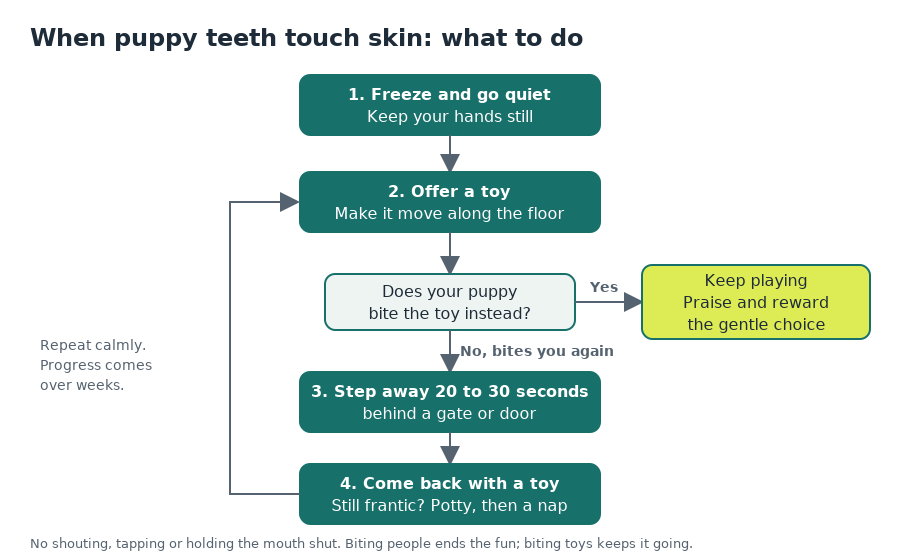 The same calm loop, repeated every time, is what teaches a puppy that toys are for biting and people are not.
Here is a quick decision guide for the situations owners ask about most.
| What's happening | What it usually means | What to do |
|---|---|---|
| Gentle mouthing during calm petting | Exploring or soliciting play | Offer a chew or toy; reward when they take it |
| Hard bite during a game | Over-aroused | Freeze, end the game briefly, restart calmer with a toy |
| Wild, frantic biting, often in the evening | Overtired | Potty break, then a nap in the crate or pen with a chew |
| Biting when picked up or brushed | Dislikes handling | Shorter handling, lots of treats, build up slowly |
| Nipping at feet and clothes as you walk | Chase play | Stop moving, redirect to a toy dragged on the floor |
| Chewing furniture, shoes or cords | Teething or boredom | Manage access, swap for an appropriate chew |
Should you say "ouch" when your puppy bites?
This is one of the places where trusted sources genuinely disagree. The AKC and VCA describe using a short, high-pitched "ow" or "ouch," which imitates a littermate's yelp and helps some puppies soften their bite. The ASPCA and Battersea, on the other hand, note that a raised voice can excite some dogs further, and PetMD's behaviorist simply recommends getting up and walking away.
A practical middle ground: try a single, short "ouch" a few times. If your puppy pauses and softens, keep using it. If they bite harder or bounce back with more energy, drop the noise and go straight to calmly ending the game.
What not to do
These approaches are common but tend to make biting worse, damage trust or both:
- Don't hit, tap the nose, scruff or hold the mouth shut. Physical corrections can make a puppy fearful of hands, and a scared dog is more likely to bite later, not less.
- Don't shout or scold. Yelling can frighten your puppy, and for some puppies any big reaction is just more attention.
- Don't encourage hand or foot chasing. Wiggling fingers or toes and wrestling with bare hands teach the exact game you're trying to stop.
- Don't roughhouse until your puppy is out of control. Keep play exciting but short, with frequent breaks.
- Don't use the crate as punishment. Downtime should be calm and comfortable, a chance to rest rather than a penalty. If your puppy struggles to settle there, see our guide on puppy crying in the crate at night.
- Don't pull away in a hurry. As above, a moving hand is a better toy than a still one.
When do puppies stop biting?
Sources give slightly different timelines, so here's the overall range. Biting is often at its most intense around 12 to 16 weeks, as teething begins. Most adult teeth are usually in by about 6 to 7 months, and many puppies mouth much less by 5 to 6 months. Some, especially large and very energetic breeds, keep mouthing in play into their first year or a little beyond.
The key word is trend. Week by week, biting should be getting softer and less frequent. Puppies who were accidentally rewarded for biting (it reliably started games or got attention) can carry the habit into adulthood, which is why consistency now pays off.
How do you stop a puppy biting children?
Children are the most common targets because they move quickly, squeal and often run, which looks exactly like play to a puppy.
- Always supervise puppies and children together, and give the puppy a gated area to retreat to.
- Teach children to "be a tree": stand still, fold arms and look away if the puppy mouths. An adult then redirects the puppy to a toy.
- Swap chase games for calm ones, like rolling a ball or scattering a few treats on the floor.
- Keep sessions short. Puppies tire quickly, and tired puppies bite more.
When to get help with puppy biting
Most mouthing is normal play, but contact a certified, reward-based trainer, a veterinary behaviorist or your vet if:
- Biting is getting harder or more frequent over several weeks instead of easing.
- Your puppy is still biting a lot at around 6 months despite consistent training.
- Bites come with a stiff body, a hard stare, deep growling, head shaking or holding on.
- Biting happens around food, toys or resting places (guarding), or when your puppy seems scared.
- Bites break skin, or anyone in the household is struggling to cope.
A sudden change in behavior can also have a physical cause, such as pain, so a check with your vet is a sensible first step.
Keep it simple
You don't need to fix every bite perfectly. You need to make good choices easy and rewarding, keep your puppy rested and give them plenty of chances to win. Biting is noisy and sore for a few months, but with a toy in one hand and a little patience, you're teaching your puppy a skill they'll use for life: a gentle mouth around people.
Common questions
Is it normal for my puppy to bite me all the time?
Yes. Young puppies explore with their mouths and play by biting, which is how they played with their littermates. Frequent, playful mouthing in a puppy under about five months is expected. It becomes a concern if it is getting harder or more frequent over several weeks, or comes with stiffness, deep growling or guarding.
Should I yelp "ouch" when my puppy bites?
Sources disagree. A short, high-pitched "ouch" mimics what a littermate does and helps some puppies soften, but it excites others and makes them bite more. Try it a few times; if your puppy comes back harder, skip the noise and simply end the game instead.
Why does my puppy bite more in the evening?
Evening "witching hour" biting is usually a sign of an overtired or overstimulated puppy. Young puppies need a lot of sleep, and when they miss naps they get mouthier, not calmer. Bring in a nap before the evening rush and offer a chew in a quiet space.
Can puppy classes help with biting?
Yes. A good reward-based puppy class gives your puppy safe play with other puppies, where they learn that hard bites end the fun, and gives you coaching on timing. Choose a class that uses positive methods and groups puppies by age and size.
How do I stop my puppy from biting my children?
Always supervise, and give children a simple job. They freeze, fold their arms and look away if the puppy mouths, then let an adult redirect the puppy to a toy. Avoid games where kids run and the puppy chases, and use a gate or pen so the puppy has calm time away when play gets too exciting.
Sources
- How to Stop Puppy Biting and Train Bite Inhibition, American Kennel Club
- How To Stop a Puppy From Biting, PetMD (Wailani Sung, MS, PhD, DVM, DACVB)
- Play Biting in Puppies, VCA Animal Hospitals (Debra Horwitz, DVM, DACVB & Gary Landsberg, DVM, DACVB)
- How to stop a puppy mouthing or biting, Battersea Dogs & Cats Home
- Inappropriate Mouthing, ASPCA
This guide is general training information. It does not replace advice from your veterinarian or a certified trainer who has met your puppy.